

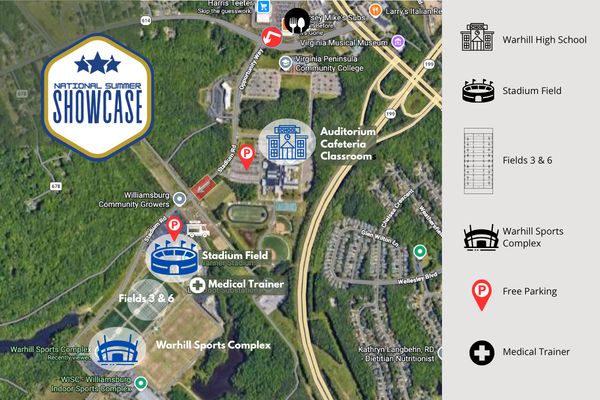
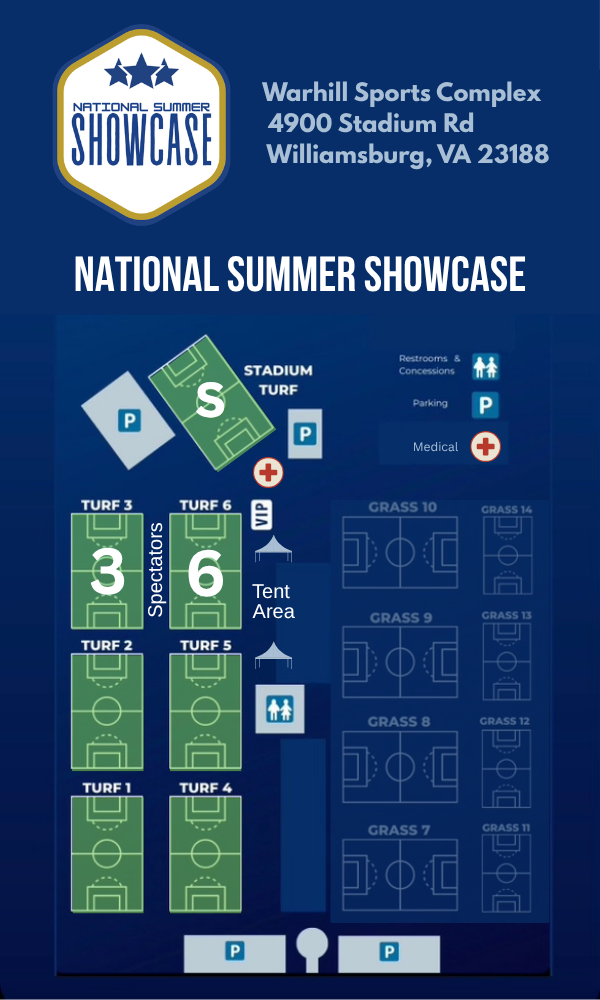
Emergency Action Plan
Accidents and injuries are inherent with sports participation, and proper preparation on the part of the sports medicine team should enable each emergency to be managed appropriately. Expedient action must be taken in order to provide the best possible care to the sport participant’s emergency and/or life-threatening conditions. The development and implementation of the emergency plan will help ensure that the best care will be provided. As emergencies may occur at any time and during any activity, all event personnel and sports medicine teams must be prepared. This preparation involves formulation of an emergency plan, proper coverage of events, maintenance of appropriate emergency equipment and supplies, utilization of appropriate emergency medical personnel, and continuing education in the area of emergency medicine and planning.
Venue Information
| Name | Warhill Sports Complex |
| Website | 4900 Stadium Road |
| GPS Address | https://maps.app.goo.gl/MuktEWcJ6xAFATjH7 |
| City | Williamsburg |
| State | VA |
| Zip Code | 23188 |
| Name | Warhill High School |
| Website | 4615Opportunity Way |
| GPS Address | https://maps.app.goo.gl/FXqRvJ25aGtTCWdv6 |
| City | Williamsburg |
| State | VA |
| Zip Code | 23188 |
Emergency Information
Communication is the key to quick emergency response. Athletic trainers and emergency medical personnel must work together to provide the best emergency response capability and should have contact information established as a part of pre-planning for emergency situations.
Emergency Contacts
| Event Directors | |
| Name | Joel Franklin |
| Telephone | 410-340-9063 |
| Joel.franklin@usarmybowl.com | |
| Nearest Hospital (4 miles. Approx. 10-minute drive) | |
| Name | Sentara Williamsburg Regional Medical Center |
| Address | 100 Sentara Circle |
| City | Williamsburg |
| State | VA 23188 |
| Telephone | (757) 984-7155 |
|
Activating the Emergency Action Plan
| Field Directors | 1. Radio request for athletic trainer |
| 2. Provide Call Color and Field Number | |
| 3. Meet Athletic Trainer and Event Director on field | |
| Staff & Volunteers | 1. Proceed to Field Number |
| 2. Meet Field Director and identify injured athlete’s name | |
| 3. Acknowledge radio call and confirm you are en route | |
| Athletic Trainers | 1. Proceed to Field Number |
| 2. Assess situation | |
| 3. Notify Event Director if critical call 911 is needed | |
| HQ | 1. Notify other athletic trainers to cover field assignments if needed |
| 2. Call 911 |
Emergency Plan Color Codes
| Code Green – No Call | Code Yellow – Radio Call | Code Red – Radio Call |
| Not Urgent | Urgent | Critical |
| Band Aid | Cramp, Muscle, Bone, Blood, Ankle, Wrist, | Unconscious, Life Threatening, Vomit |
Athletic Trainer Protocol
Certified Athletic Trainers will be on-site to manage health care problems associated with the lacrosse event.
| 1-athletic trainer for every 2-regulation size fields
Athletic trainers will have radios to communicate with Field Director, Staff and Event Director Golf carts will be made available for large- scale field venues |
| Primary Role:
1. Provide injury Evaluation, Treatment and First Aid to injuries and wounds |
| Evaluation and Primary Care | For Mild to Moderate Injury | For Severe Injury |
| Provide basic standard of care to athlete - Do No Harm | Stabilize |
Stabilize
|
| Athletic trainer will evaluate injury at the request of the coach, official, athlete or parent | I.C.E. |
ABC's
|
| Referral to appropriate medical personnel/facility if necessary | Call 911
|
|
| Wrapping, strapping, taping, padding – all athletes are advised to bring their own supplies (limited supply on-hand) | Contact Event Director with A. Field Number B. Possible Injury Concerns C. Request for someone to direct EMS to injured athlete |
|
| Advise follow-up care for day/night to athlete, coach, parent |
| Radio Etiquette | When A Call Is Received |
| Event Staff Operations on Channel 1 | 1. Answer call on radio |
| 1. When calling on the radio, identify yourself then who you are calling: “Trainer to Field 3” | 2. Repeat the call color and field number |
| 2. Wait for response: “Go for Trainer” | 3. Proceed to field number with urgency |
| 3. Then state your message: “I’m on my way to Field 8” | 4. Assess injured athlete and situation |
| Tournament related talk ONLY
Switch to another Channel for longer conversations. Immediately switch back to Channel 1 after conversation. |
5. Provide basic care and stabilize as needed |
| Avoid using your smartphone unless there is a critical emergency need to call 911 | 6. Move injured athlete to sideline or escalate to critical call 911 |
| 7. Document the incident |
Critical Medical Emergency
Call 911
| Provide Information | Additional Information Needed |
|
1. What is the victim’s age? |
Weather Protocols
Severe weather is always a concern with outdoor athletic activities. Goat Farms Sports has developed a weather emergency action procedure to ensure, to the best of our ability, the safety of each participant, coach, parent and spectator.
| Weather Related Adjustments | Roadways and Parking Lots |
| In the event of field closures and/or unplayable field conditions or adverse or threatening weather conditions, including rain, wind, lightning, excess heat and/or humidity, tournament organizers reserve the absolute and unfettered right to: | Please do not park in a manner that block emergency access points, which may be identified by signage. If you see a vehicle blocking an emergency access point, please notify Event Headquarters. Thank you.
|
| 1. Cancel and or postpone further play in whole or in part |
Use caution in all parking areas. Park in designated areas only Please obey all parking signs. DO NOT park on private property. Violators may be ticketed or towed. Do not walk on the road from parking areas to fields, but only in designated walkways. Use caution when crossing streets. Players should be accompanied by adults when crossing streets Be aware of heavy traffic around tournament venues. Use caution and courtesy
|
| 2. Reduce times to catch up with schedule, whether caused by cancellations, postponements, or to accelerate the schedule to avoid the onset of adverse or threatening weather conditions | |
| 3. Revise the schedule, including modifying times and rules and or canceling certain games | |
| 4. Interrupt and suspend games as necessary; games that are continued from the point of interruption may be subject to modified rules if they resume, as circumstances warrant | |
| 5. Finish or end games before inclement weather arrives or to preserve field conditions | |
| 6. Games that stat but are truncated of necessity will be deemed official at the point of termination regardless of actual duration | |
| § No refunds will be issued due to any weather-related adjustments during the tournament |
| Types of Weather | |
|
|
| Lightning and Threatening Storm | Extreme Heat |
| In the event there is a lightning strike within 10 miles of the venue fields 5-horn blasts will be sounded. Everyone is to take shelter in their cars and await further instruction. | The National Athletic Trainers' Association recommends using onsite wet-bulb globe temperature (WBGT) measurement to determine whether to modify or cancel physical activity.
The most widely used is the Wet Bulb Temperature (WBGT) index, which was developed by the U.S. Marines and estimates heat stress on players in direct sunlight by taking into account actual temperature, humidity, wind speed, sun angle, and cloud cover: The WBGT measurements should be taken regular intervals on each outdoor athletic playing surface to adequately capture the environmental conditions affecting physical performance and the risk of heat illness. Above 87 F: Consider modifying playing time At 92 F: Stop play Should the wet-bulb temperature of the playing surface reach 87 F (or when the relative humidity is 95% or higher, regardless of wet-bulb reading) Game time may be shortened, rescheduled or canceled, breaks added.
|
| Earthquake | |
| 1. Seek inside shelter | |
| 2. Assist people with disabilities in finding a safe place | |
| 3. Small interior rooms and hallways on the lowest floor without windows | |
| 4. Avoid outside walls and windows | |
| Tornado | |
| Stay calm and await instructions from the Emergency Coordinator | |
| Avoid overhead fixtures, windows, and electrical power | |
| 1. Assist people with disabilities in finding a safe place | |
| 2. Evacuate as instructed by Event Director | |
| 3. Use arms to protect head and neck | |
| 4. Remain sheltered until the tornado threat is announced over | |
| Flood | |
| If Indoors | |
|
|
| If Outdoors | |
|
|
| Hurricane | ||
| The nature of a hurricane provides for more warning than other natural and weather disasters. A hurricane watch issued when a hurricane becomes a threat to a coastal area. A hurricane warning is issued when hurricane winds of 74 mph or higher, or a combination of dangerously high water and rough seas, are expected in the area within 24 hours | ||
| Once a hurricane watch hs been issued | During a Hurricane | |
| 1. Stay calm and await instructions from the Local Emergency Coordinator or the designated official. | Remain indoors and consider the following: | |
| 2. Continue to monitor local TV and radio stations for instructions | 1. Small interior rooms and hallways on the lowest floor constructed with reinforced concrete, brick or block with no glass.
|
|
| 3. Move early out of low-lying areas or from the coast, at the request of officials | ||
| 4. If you are on high ground, away from the coast and plan to stay, secure the building, moving all loose items indoors and boarding up windows and openings | ||
| 5. Collect drinking water in appropriate containers | ||
| Once a hurricane warning has been issued | ||
| 1. Be ready to evacuate as directed by the Event Director or Emergency Coordinator | ||
| 2. Leave areas that might be affected by storm tide or stream flooding | ||
Common First Aid Symptoms and Care
The following are general information and suggested. No situation will be the same. When in doubt call 911 and complete rescue to your best level of training and ability.
Types of Medical Conditions
| Concussion Awareness and Injury Prevention | |
| A concussion is a serious injury and should not be taken lightly. It is a type of traumatic brain injury, or TBI, that can be caused by a bump, blow or jolt to the head that can change the way your brain normally works. They can also occur from a blow to the body that causes the head to move rapidly. Even a mild bump or blow to the head can be serious.
Unfortunately, concussions can be difficult to diagnose, in part because the symptoms can be subtle and may not show up for hours or even days. For these reasons, it is important that parents, coaches and athletes take time to understand what concussions are and their potential consequences, recognize concussion signs and symptoms, know how to respond, and learn the steps for returning to activity after a concussion. If you suspect an athlete has a concussion, keep the athlete out of play (“when in doubt, keep them out”). |
The athlete must be evaluated by a health care professional experienced in evaluating concussions to assess the severity of the concussion, the path to recovery and the steps to return to play.1. All Coaches are required to sit a player out for the remainder of a game if the player sustains a blow to the head or a jarring collision that causes the coach or the trainer to suspect a possible mild or traumatic brain injury.
2. The coach is required to notify the trainers regarding any such incident to permit assessment by a trained professional. If a coach or trainer suspects a concussion and requires a player to sit out, that player will not be allowed to return to play in the tournament without written clearance from a medical professional. |
| Diabetic Emergencies | |
| Symptoms | Care |
| Changes in level of consciousness, including dizziness, drowsiness, and confusion | 1. Call 911 |
| Rapid breathing | 2. Ask victim if they are diabetic |
| Rapid pulse | 3. Give sugar |
| Feeling and looking ill | If the victim does not feel better after giving sugar:
§ Monitor pulse and breathing § Keep victim from getting chilled or overheated |
| Fainting | |
| Symptoms | Care |
| Lightheadedness or dizziness | 1. Call 911 |
| Pale, cool, moist skin | 2. Elevate legs |
| Nausea | 3. Loosen restrictive clothing |
| Tingling or numbness | 4. Monitor pulse and breathing |
| Heat Cramps | |
| Symptoms | Care |
|
Muscle spasms, usually in the legs and abdomen
|
1. Rest in a cool place |
| 2. Give cool water | |
| 3. Loosen restrictive clothing | |
| 4. Stretch or massage the muscle gently | |
| 5. Do not administer salt | |
| Heat Exhaustion | |
| Symptoms | Care |
| Normal or above normal body temperature | 1. Move to a cool place |
| Cool, moist, pale, or red skin | 2. Sup fluids (water or sports drinks only) |
| Headache | 3. Apply cool, wet towels to the body and fan |
| Nausea | 4. Minimize shock |
| Dizziness and weakness | 5. Monitor pulse and breathing |
| Exhaustion | 6. If conditions worsen and become heat stroke - call 911 |
| May sweat profusely | |
| Heat Stroke | |
| Symptoms | Care |
| Red, hot, dry skin | 1. Call 911 |
| Changes in consciousness | 2. Move to a cool place |
| Rapid, weak pulse | 3. Apply cool, wet towels to the body |
| Rapid, shallow breathing | 4. Loosen restrictive clothing |
| 5. Give sips of water if fully conscious | |
| 6. Minimize shock | |
| 7. Monitor pulse and breathing | |
| Heart Attack - Male | |
| Symptoms | Care |
| Chest pain | 1. Call 911 |
| Discomfort in arm(s), neck, jaw, back or stomach | 2. Direct victim to a comfortable position |
| Shortness of breath, nausea, sweating | 3. Loosen restrictive clothing |
| Indigestion or heartburn | 4. Monitor pulse and breathing |
| Irregular/no pulse | 5. Offer aspirin if not allergic, does not have stomach issues, is not on blood thinners or not told by a doctor to avoid aspirin |
| Heart Attack - Female | |
| Symptoms | Care |
| Unusual fatigue | 1. Call 911 |
| Sleep disturbance | 2. Direct victim to a comfortable position |
| Shortness of breath | 3. Loosen restrictive clothing |
| Indigestion or heartburn | 4. Monitor pulse and breathing |
| Anxiety
Dizziness Discomfort/pain in arm(s), back, jaw, or stomach |
5. Offer aspirin if not allergic, does not have stomach issues, is not on blood thinners or not told by a doctor to avoid aspirin |
| Chest discomfort or tightness | |
| Irregular/no pulse | |
| Hypothermia | |
| Symptoms | Care |
| Shivering (may be absent in later stages) | 1. Call 911 |
| Slow irregular pulse | 2. Remove wet clothing and dry the victim |
| Numbness | 3. Warm the body gradually by using blankets |
| Glassy stare | 4. Give warm liquid slowly if fully conscious |
| Apathy and decreasing level of consciousness | 5. Minimize shock |
| 6. Monitor pulse and breathing | |
| Nose Bleed | |
| Symptoms | Care |
| Blood draining from either nostril | 1. Have victim pinch off at the bridge of their nose |
| Tilt head forward – spit our excess blood | 2. Tilt head forward |
| If head is tilted back blood may drain into the sinuses, mouth or stomach potentially causing blood in mouth or vomit | 3. Administer ice of bleeding was caused by impact of an object causing pain and swelling |
| 4. If bleeding last more than 10 minutes - call 911 | |
| Poisoning | |
| Symptoms | Care |
| Nausea | 1. Call 911 |
| Vomiting | 2. Monitor pulse and breathing |
| Diarrhea | 3. Call Poison Control center (800-222-1222) |
| Chest or abdominal pain | 4. Follow PCC directions |
| Breathing difficulty | |
| Sweating | |
| Loss of consciousness | |
| Seizure | |
| Severe Bleeding | |
| Symptoms | Care |
| Bleeding cannot be controlled by direct pressure and elevation | 1. Call 911 |
| Bleeding lasts for more than 10 minutes of direct pressure | 2. Apply direct pressure to wound and elevate |
| Bleeding threat to persons survival | 3. If bleeding persists or soaks through, use additional barriers |
| 4. Minimize shock | |
| Seizure | |
| Symptoms | Care |
| Non-responsive daydream state | 1. Call 911 |
| Shaking (mile or violent) | 2. Protect victim’s head and airway |
| Body becomes rigid | 3. Post seizure make victim comfortable |
| Post seizure victim may appear sleepy, in a state of stupor, may stop breathing | 4. Victim should not drive |
| Shock | |
| Symptoms | Care |
| Cold sweat on forehead | 1. Call 911 |
| Cold and clammy hands | 2. Elevate feet |
| Nausea | 3. Control any bleeding |
| Dizziness | 4. Monitor pulse and breathing |
| Weakness | |
| Pale appearance | |
| Feeble pulse | |
| Shallow or irregular breathing | |
| Spinal (Head, Neck, Back Injury) | |
| Symptoms | Care |
| Fall from a height greater than their own | 1. Call 911 |
| Dive into shallow water | 2. Immobilize head, neck and back |
| Deformity, pain, bruising, tenderness, along the spine | 3. Check breathing and pulse |
| High impact accident | 4. Monitor pulse and breathing |
| Stroke | |
| Symptoms | Care |
| Numbness of the face, arm or leg – usually on one side of the body | 1. Call 911 |
| Difficulty speaking | 2. Note time of symptoms onset |
| Blurred or dim vision | 3. Keep victim comfortable and monitor pulse and breathing until EMS arrives |
| Cannot form a simple sentence or stick tongue straight out | |
Emergency Situations
In the case of a critical medical, fire or public safety issue, CALL 911 and contact the HQ/Event Director as soon as possible.
| Death or Severe Injury | What to do: |
| A death or severe injury is a possibility at any event. Any situation of this nature should be treated with utmost respect and care for friends and family of the victim(s) | 1. Initiate Code RED Emergency Action Plan – Call 911, Radio HQ |
| 2. Isolate the Victim and continue care until EMS asks you to stop, or if you are exhausted | |
| 3. Treat family, friends, volunteers, staff and spectators for shock making them comfortable as possible | |
| 4. Document incident and gather witness contact information and statements | |
| 5. Do not share information | |
| 6. With permission from EMS clean up any pathogens left by the incident | |
| 7. The Event Director will decide to continue or stop the remainder of the tournament. | |
| 8. Debrief with all involved | |
| Fire | What to do: |
| A fire is considered major if it requires a fire extinguisher or EMS to extinguish. If people are in even remote danger the fire is considered major. | 1. Initiate Code RED Emergency Action Plan – Call 911, Radio HQ |
| 2. Completely evacuate structure or area | |
| 3. People may re-enter the structure or area only when instructed to do so by EMS | |
| 4. Document all fires large or small | |
| Fights | What to do: |
| Adult spectators have attacked each other, coaches and officials. Taking proper steps to insure these situations are dealt efficiently without putting others in a dangerous situation is a critical task. | Between Adults
Do not get between the two fighting adults |
| 1. Initiate Code RED Emergency Action Plan – Call 911, Radio HQ |
|
| 2. Without physical contact separate the two as much as possible and control bystanders | |
| 3. Simply tell them the police are on the way and that they are to stop immediately | |
| 4. Simply tell them the police are on the way and that they are to stop immediately | |
| 5. Document incident and have witnesses document incident independently | |
| Between Adult and a Child
The procedure is the same as with two adults |
|
| 1. Do whatever you can to stop the fight verbally | |
| 2. Do not physically interfere |
| Fights | What to do: |
| Between Two Children
|
1. Initiate Code YELLOW Emergency Action Plan Radio HQ |
| 2. If the children are small enough to easily separate do so | |
| 3. Initiate Code YELLOW Emergency Action Plan Radio HQ | |
| 4. It may be necessary to ask a parent or other family member for assistance | |
| 5. Monitor the parents/guardians and friends of those fighting to prevent further violence | |
| 6. Interview witnesses and document |
| Natural Disaster and Hazardous Spill | What to do: |
|
A Natural Disaster is any uncommon occurrence caused by Mother Nature. Natural disasters that may happen in the Pacific Northwest include floods, volcanic eruptions, earthquakes, and tidal waves. Hazardous Material spills are recognized in different ways. Common factors are smell, a spill, or discoloration of water or air. People are becoming ill or losing consciousness with no obvious cause |
1. Initiate Code RED Emergency Action Plan – Call 911, Radio HQ and Event Director |
| 2. Communicate to the best of your ability with other coordinators to determine the extent of damage/injuries, if any | |
| 3. Determine how to best maintain the safety of the individuals in your area | |
| 4. If necessary communicate and coordinate with EMS |
| Exposure Control Plan | What to do: |
| Potential Exposure is defined as any event where the body tissues, fluids or wastes of a person(s) may have any potential of entering the body of another individual(s). This would include ingestion and through cuts or mucous membranes.
All exposures will be treated as hazardous.
|
1. Initiate Code RED Emergency Action Plan – Call 911, Radio HQ and Event Director |
| 2. Use gloves or other barriers when performing or assisting with first aid or CPR | |
| 3. Immediately wash hands and other exposed areas thoroughly with soap and hot water | |
| 4. Remove and isolate potentially contaminated clothing in a biohazard container | |
| 5. Document incident detailing any type of exposure |
| Power Outage | What to do: |
| If you are in danger or feel threatened, call 911
|
1. Initiate Code YELLOW Emergency Action Plan – Radio HQ and Event Director |
| 2. Remain calm | |
| 3. Follow directions provided by the venue facility communication system | |
| 4. If building evacuation becomes necessary, seek out persons with special needs, provide assistance if possible | |
| 5. Unplug electrical equipment, including computers, secure all vital equipment, records, and materials if safe to do so | |
| 6. Do not light candles or other types of flames for lighting. | |
| Event Director | 1. Assess the situation |
| 2. If there is total darkness in the facility, use a bull horn, or loud voice to make script announcement #1 | |
| 3. Contact venue facility engineering and maintenance staff | |
| 4. Contact local utility company if necessary | |
| 5. Communication with officials, coaches how the situation will be handled | |
| Emergency Situations
|
|
| Script #1 | Script #2 |
| Ladies and gentlemen - Due to the power outage that just occurred, we must temporarily suspend the contest. For your safety and the safety of others, we ask you to remain in place (or be seated), calm and quiet while we attend to this matter. Further information will be provided as soon as it becomes available. | Ladies and gentlemen - We are unable to restore power and this event has been cancelled. We ask that you be extremely careful as you exit the facility by way of the emergency exit signs. Information regarding the rescheduling of this contest will be available from you school activities office.
|
| Sexual Predator | What to do: |
| This would be someone you feel may be a predator due to their behavior. Behavior to watch includes, inappropriate touching, unusual alone time, excessive gifts, etc | 1. Initiate Code YELLOW Emergency Action Plan – Radio HQ and Event Director |
| 2. Monitor individual | |
| 3. Document inappropriate behavior and, if possible, note any information that may assist with identifying the individual i.e. license number, photo with your smartphone | |
| 4. If individual commits any illegal act, without physically interfering, tell them to stop immediately and CALL 911 |
| Missing Person | What to do: |
| A Missing Person is one who is presumed to be a victim of some type of injury or other type of hazard at an unknown location. It may be a lost child, a participant who has not returned or another similar situation.
|
1. Initiate Code YELLOW Emergency Action Plan – Radio HQ and Event Director |
| 2. Monitor individual | |
| 3. Keep the reporter with you until the victim is found or an equally/more qualified person takes over for you | |
| 4. Get a description of the missing person including team, division, age, gender, hair color, clothing, and other identifying characteristics | |
| 5. Determine the missing persons last known location | |
| 6. If the last known location was in the water or other hazardous area contact EMS 911 | |
| 7. Send other people to scout specific locations and return. | |
| 8. Re-send them until the person is found | |
| 9. Use a phone to call possible locations/people |
| Media | What to do: |
|
During an emergency (or “incident”), the Communications plan should govern all communications within an organization and with external stakeholders, including the media.
|
1. Refer all questions regarding any incident or accident to the Event Director. If pressed simply say no comment. |
| 2. Provide event information or flyers you feel may be helpful | |
| 3. Be as helpful and honest as possible Incidents or Accidents | |
| 4. Do not give out information unless you are specifically told to do so |
Evacuation Plan
When deciding when to evacuate, the Event Director should consider the severity of the situation, the chance that the situation could escalate and the possibility that the situation could become uncontrollable based on resources available.
| Evacuation | What to do: |
| There may be conditions under which you will decide to get away or there may be situations when you are ordered to leave. Follow these guidelines for evacuation:
|
1. Event Director to initiate Emergency Action Plan |
| 2. Notify by radio all event staff advising them to direct people to evacuate to the assembly points on the site map | |
| 3. Field Marshals and Area Leaders ensure the venue is vacated including public areas, closed rooms and toilets |
OVERVIEW
July 14-17, 2026
Tackle-Boys
High School
July 15-17, 2026
Flag-Girls
Middle + High School
July 17-19, 2026
Tackle-Boys
Middle School
- Showcase opportunity with elite training and exposure designed to elevate your football journey.
- World-class event featuring NFL coaches, sports scientists, and college recruiters.
-
20+ years of experience developing 1,000+ Division I / pro athletes and identifying and showcasing the nation’s top football talent.
- Tackle athletes included in Tom Lemming’s 2026 Prep Football Report (gold, silver, and bronze editions)
Why Attend?
- The football world has dramatically changed – the stakes are higher than ever before
- NCAA athletes will soon be paid, and today’s high school athletes can be top earners before an NFL career
- Training and exposure are critical to maximizing this opportunity
- By attending, athletes will receive:
- Honest evaluation
- Strengths & weaknesses report
- Year-round training plan
- Consideration for All-American selection
SELECTION PROCESS
Invitation Only. Methods for Invite.
- Selected by local or regional scout
- Alumni of The National Combine, The Academy or Middle School National Championship
- Scouted at official national partner events (Signing Day Sports and others)
- Nominated (by coach, parent or athlete) for review by scouting committee
To participate, athletes must either be scouted by a regional director or submit a coach's nomination. Coaches can formally put players on the radar through the official U.S. Military Appreciation Week athlete nomination portal.
Be Seen Decxember 18-20, 2026 during Military Appreciation Week at The Star in Frisco, Texas - home to The Dallas Cowboys.

BE A PART OF HISTORY
America's Biggest Week in Football will feature the All-American Bowl with 80 of the best high school football players in the nation. The National Combine will be taking place at the Dallas Cowboys "STAR" Ford Center Stadium during Bowl week. Legendary NFL and College Coaches will be in Dallas to see all the Bowl Showcase Events including: the Bowl, the All-American Flag Bowl, the Club Flag Football Tournament, Middle School and Youth Tackle Football Championships, and the All-American Cheer program.
A FOOTBALL PIPLINE - WHO ARE WE



For more than twenty years, our team has identified, trained and showcased over 1,000 Division I and NFL athletes.
We own and manage the Nation’s Biggest Showcase Event in Frisco, Texas named The National Combine, The Football Academy and the Military Appreciation Bowl (formerly the U.S. Army Bowl) hosted by the Dallas Cowboys.
We identify, track and rank the nation’s top ballers from middle school to the NFL.
Our football development comes from the very best minds and practitioners in major college football and the NFL.
Our inspiration comes from our passionate team that played the game and had their lives changed by it.
Our team, coaches and our training systems have been featured in the USA Today, the Wall Street Journal, Sports Illustrated and MTV.
Be Seen at Military Appreciation Week at The Star in Frisco, Texas - home to The Dallas Cowboys
Nominate yourself today and earn the opportunity to compete on football's biggest stage in Frisco, Texas.
PREMIER SPONSORS